Systems
How to connect your website to the tools that actually run your business
Retail stores want online sales.
Service businesses want appointments.
Restaurants want orders.
But most websites don’t lose customers because the design is “bad.”
They lose customers because the system behind the buttons doesn’t work.
The “Buy now,” “Book now,” and “Order now” experience is only as strong as the handoffs behind it:
inventory, scheduling, confirmations, reminders, payment, fulfillment, and follow-up.
If those handoffs are messy, your website feels unreliable even when the brand looks great.
And when a website feels unreliable, people don’t take the next step.
Quick test
Pretend you’re a first-time customer and try to complete the main action on your site.
Can you purchase, book, or order in under 60 seconds without confusion?
And do you get a clear confirmation immediately after?
The reality
A website is not a brochure anymore. It’s an operating system.
A modern website is the front door to the business.
It’s where customers decide if you’re credible, and it’s where they try to do something real.
Not “learn more.” Do.
For most of our clients, the website needs to connect to one of three engines:
ecommerce, booking, or online ordering.
When those systems are connected, the business feels smooth.
When they aren’t, leads slip, orders fail, and teams spend their day doing manual cleanup.
What to prioritize
The only three things your “money pages” have to do
Whether you sell products, appointments, or food, your highest-performing pages share the same job.
They need to create clarity, remove friction, and make the next step obvious.
1. Make the offer instantly clear
Most websites explain the business.
The best ones explain the outcome.
What should a customer expect if they buy, book, or order right now?
One sentence can do a lot of work:
what you do, who it’s for, and what happens next.
2. Reduce steps and uncertainty
Every extra click is a chance for drop-off.
Every unanswered question is a reason to pause.
The goal isn’t to add more information.
It’s to remove hesitation.
3. Confirm the next step immediately
Conversions don’t end at the click.
They end when the customer feels confident it worked.
Confirmation pages, emails, texts, and reminders aren’t “nice to have.”
They’re part of the product.
By business type
What “connected” looks like for retail, service, and restaurants
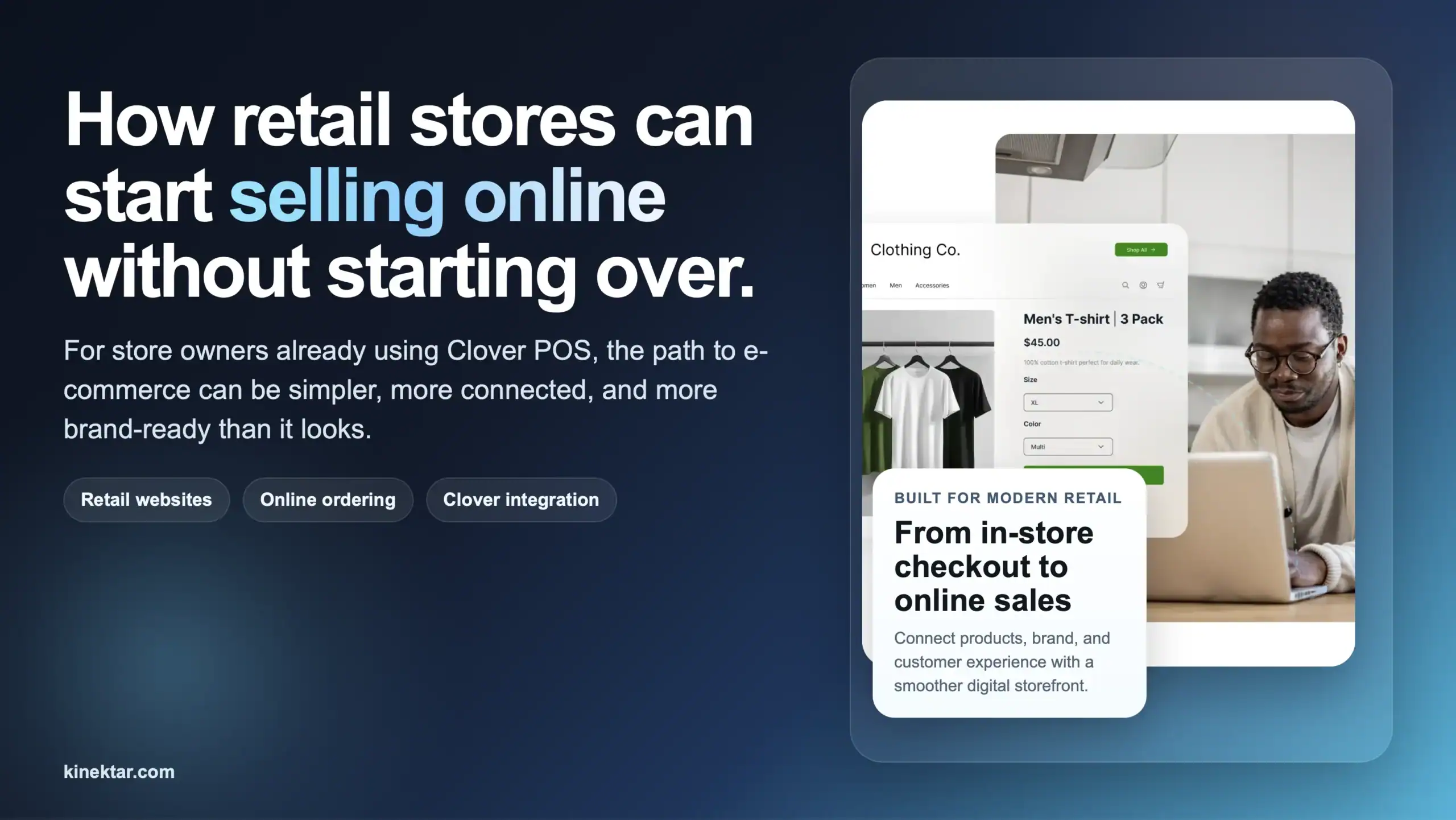
Retail and ecommerce: make buying feel effortless
Ecommerce is not just “add a shop.”
It’s product discovery, trust, and checkout flow.
If customers can’t find what they want quickly, or checkout feels clunky, the sale dies quietly.
The simplest ecommerce system should answer:
Is it in stock?
How fast can I get it?
What’s the return policy?
What happens after I buy?
A connected setup means:
inventory is accurate, payment is reliable, receipts are automatic, and fulfillment is clear.
Service businesses: booking should replace back-and-forth
If your website says “contact us” for everything, you’re choosing friction.
The goal is to turn high-intent visitors into scheduled time without a long email chain.
A connected booking system means:
availability is real, confirmations are instant, reminders reduce no-shows,
and the intake form captures what you need before the call.
If you’re still manually following up on every inquiry, the problem isn’t effort.
It’s that the system isn’t doing the work.
Restaurants: online ordering has to be fast and forgiving
The restaurant customer is usually on a phone and in a hurry.
If the menu is hard to read, modifiers are confusing, or checkout is slow, they bounce.
A connected ordering system means:
accurate hours, clear pickup and delivery options, smooth payment, and immediate confirmation.
And on the business side, orders land where your team actually works.
Common mistakes
The 4 system gaps that quietly kill conversion
Gap 1. The website and the “real tools” don’t match
The homepage promises one experience.
The booking flow feels like another brand.
The ordering link opens a different site.
The checkout looks unfamiliar.
When the experience feels stitched together, customers lose confidence.
Consistency is a conversion tool.
Gap 2. No ownership of the next step
If a form submission comes in and no one owns it, it dies.
If an order issue happens and there’s no clear process, it becomes a customer service fire.
Systems need an owner, not just software.
Gap 3. Slow confirmations and slow follow-up
Customers don’t like uncertainty.
If they don’t receive a confirmation right away, they assume something broke.
And if leads don’t hear back quickly, they move on.
Gap 4. No tracking beyond “traffic”
Traffic is not the KPI.
Purchases, bookings, and orders are.
If you don’t know where people drop off, you’ll keep “improving the website”
while the real bottleneck stays untouched.
What we do
We build websites that connect to revenue, not just design
At Kinektar, we build conversion-focused websites for retail, service, and restaurant businesses.
The goal is simple:
your site should make it easy to buy, book, or order, and easy for your team to fulfill and follow up.
That usually means designing the right pages, then connecting the right systems:
ecommerce or ordering, booking, email and SMS confirmations, and clean handoffs into your CRM or inbox.
If your website looks good but the “money actions” feel inconsistent,
it’s almost always a systems issue, not a creativity issue.
Bottom line
Make the next step easy, and the follow-through automatic
The best website experience is the one that feels obvious.
Clear offer, fast action, immediate confirmation, and a reliable process behind it.
If you want a quick sanity check, we can review your ecommerce, booking, or ordering flow
and tell you what to fix first to increase conversion and reduce manual work.