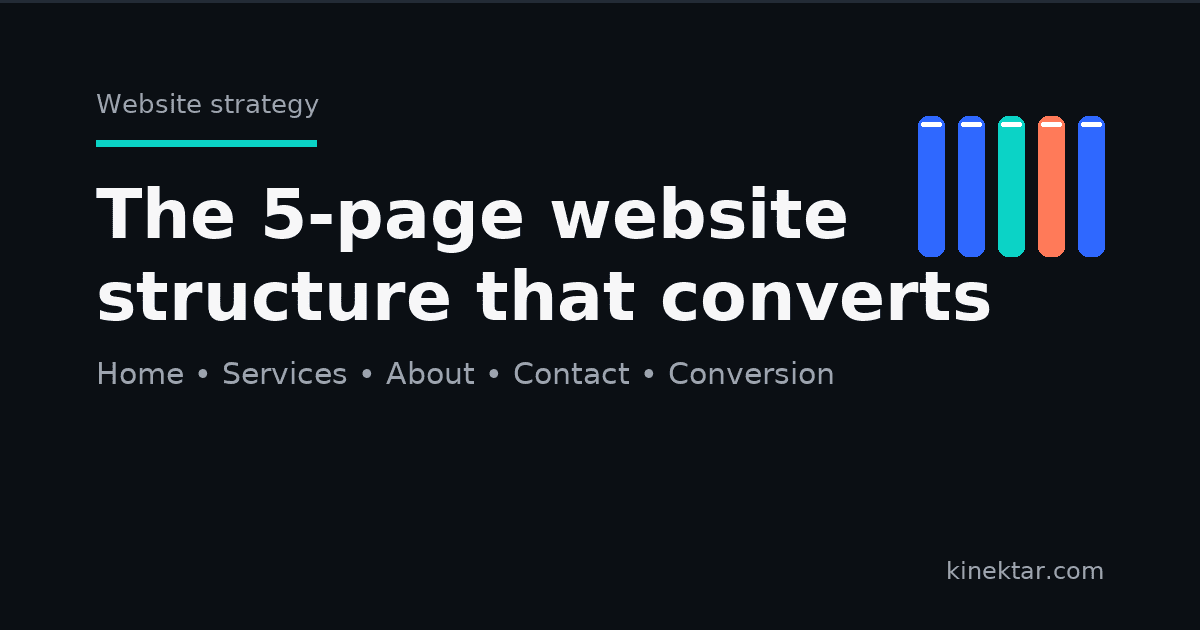
Website strategy
Why most websites don’t convert
Most websites don’t have a traffic problem. They have a clarity problem.
If a visitor can’t quickly answer “What do you do?”, “Is this for me?”, and “What should I do next?”, they bounce. The fix usually isn’t adding more pages — it’s tightening the path.
A simple 5-page structure is often enough to turn a “pretty brochure” site into a site that actually generates leads.
Quick test
If someone lands on your homepage and can’t explain what you do in 5 seconds, your site isn’t failing on design — it’s failing on clarity.
The framework
The 5 pages you actually need
This is the structure we use because it’s simple, scalable, and built around how people actually make decisions online.
1) Home — your orientation page
Your homepage is not your brand manifesto. It’s your strongest orientation page.
It should do three things fast
- Explain what you do in plain language
- Prove you can do it (credibility)
- Point to the next step (usually Services or a Conversion page)
Include
- A clear headline and short supporting subhead
- One primary call-to-action (CTA)
- A quick “how it works” overview
- Proof (logos, testimonials, outcomes)
2) Services — the decision page
People click “Services” to see if you solve their problem and whether they trust your approach.
Include
- Who it’s for
- What’s included
- Your process (what happens, step by step)
- Typical timelines
- FAQs that reduce hesitation
3) About — the risk reducer
A good About page reduces risk. It’s not your full story — it’s proof you’re the right partner.
Include
- Your point of view
- How you work and what you care about
- Relevant credibility (experience, results, examples)
- A CTA that points to the next step
4) Contact — remove friction
Your contact page should be clean and predictable.
Include
- One primary form
- What happens after submission (set expectations)
- Any qualifying info you truly need
Rule
If you don’t use a form field to make a decision, delete it.
5) Conversion page — the missing piece
This is the page most sites miss. A conversion page is a dedicated page with one job — turn a specific visitor into a lead with a specific offer.
Examples
- Request a website teardown
- Get a homepage copy review
- Book a strategy call for a specific service
Unlike a general Contact page, a conversion page works because it’s focused and removes uncertainty.
Make it work
What makes the conversion page convert
- One goal — one CTA, one action, one decision
- Clear promise — what they get and when they get it
- Proof — testimonials, examples, or a short case study snippet
- Low friction — short form, clear next steps, minimal distractions
Avoid these
Common mistakes to avoid
- Making the homepage do everything instead of giving visitors a path
- Hiding the CTA until the bottom of every page
- Using vague language instead of outcomes
- Sending everyone to Contact when they need a more specific offer
Want help mapping this to your site?
Start by building one Conversion page offer. Once you have that, every other page can point somewhere specific — and your traffic finally has a job.